Accurate sheet weight begins with a simple question: how to calculate aluminium sheet weight without trusting an unchecked estimate? In practice, the answer depends on thickness, length, width, alloy density, and unit consistency. A 2,000 × 1,000 × 2 millimetre sheet may look straightforward, yet a small thickness error changes the final mass noticeably.
The standard calculation is length × width × thickness × density. Convert every dimension into metres before multiplying. Pure aluminium is commonly estimated at 2,700 kilograms per cubic metre, a reference value supported by engineering data from NIST. However, commercial alloys differ slightly. The Aluminum Association’s Aluminum Standards and Data identifies alloy-specific compositions and designations, while ASTM B209/B209M establishes requirements for aluminium and aluminium-alloy sheet and plate. These references improve technical reliability, but they do not replace the supplier’s certified mill data.
For example, a sheet measuring 2 metres by 1 metre and 0.002 metres thick has a volume of 0.004 cubic metres. At 2,700 kilograms per cubic metre, its theoretical weight is 10.8 kilograms. Simple enough.
Real production is less perfect. Rolling tolerances, surface coatings, trimming, and moisture can affect the scale reading. The International Aluminium Institute’s industry statistics also show the importance of distinguishing aluminium products by grade and form. A practical calculation should therefore state its density source, dimensional tolerance, and whether packaging is included. Recheck the units. One misplaced millimetre can create a surprisingly large error. When purchasing material, compare the calculated result with the supplier’s weighbridge record and certificate. That extra comparison is often where accuracy becomes dependable.
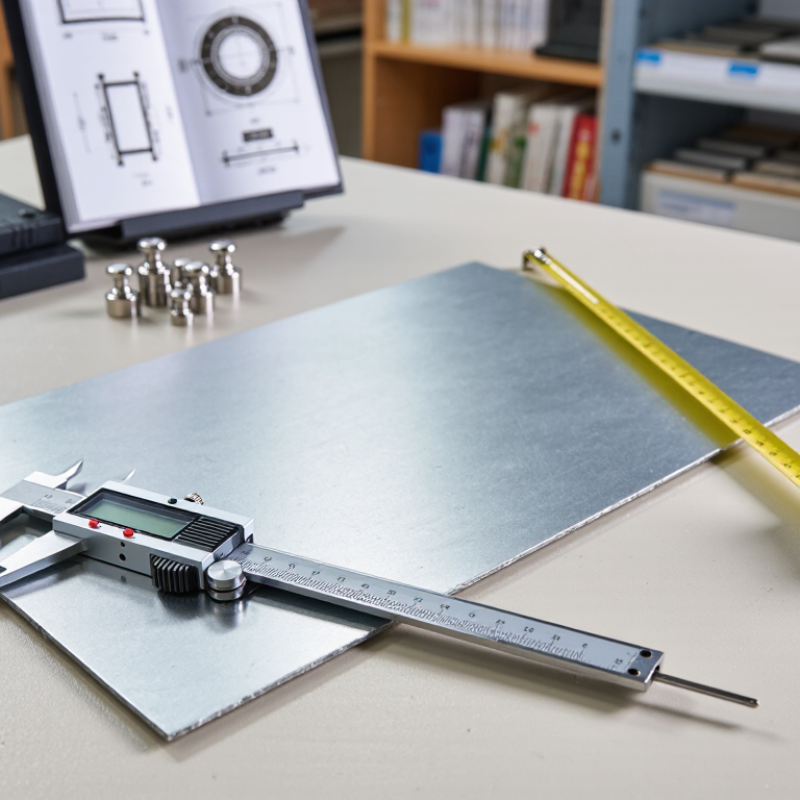
Define the sheet’s length, width, and thickness before calculating its weight. Measure length and width in millimetres with a reliable steel rule or caliper. Check thickness at several points using a calibrated micrometer. Aluminium sheets may vary slightly across their surfaces. Do not rely only on the nominal thickness.
The basic formula is:
weight in kilograms = length × width × thickness × density ÷ 1,000,000.
Use millimetres for all three dimensions. For example, a 2,000 mm × 1,000 mm × 2 mm sheet with a density of 2.70 g/cm³ weighs about 10.8 kg. The result changes when the dimensions change. Even a small thickness difference matters over a large area.
The aluminium grade must also be identified accurately. Pure aluminium and alloyed sheets have different densities. Many common grades fall near 2.66 to 2.85 g/cm³, but the correct value should come from the material certificate or technical datasheet. Temper information, such as heat-treated or work-hardened condition, usually does not greatly change the calculation, but it confirms the material specification. Include coatings, films, or trimmed edges only when the purchasing requirement demands it. A neat calculation can still be wrong. I would record both nominal and measured values, then compare the result with the supplier’s stated tolerance.
Accurate aluminium sheet weight begins with the correct alloy density. Do not automatically use 2.70 g/cm³ for every sheet.
Pure aluminium is close to 2.70 g/cm³, while common alloys may range from about 2.66 to 2.85 g/cm³. Check the material certificate or technical datasheet before calculating.
Density matters.
Use this formula:
Keep all dimensions in millimetres, and enter density in grams per cubic centimetre. For example, a 2,000 mm by 1,000 mm sheet with 3 mm thickness and 2.70 g/cm³ density weighs approximately 16.2 kg.
I once estimated weight using a standard density without checking the alloy designation. The result looked reasonable, but it created a small difference across a large order. That mistake showed why traceable material information matters.
Surface coatings, protective films, and manufacturing tolerances can also affect the final scale reading. Measure thickness at several points, especially near cut edges or formed areas. A nominal 3 mm sheet may not measure exactly 3 mm. Consider the average thickness when precision is important.
Recheck the units.
For purchasing, lifting plans, or structural calculations, compare the calculated value with an actual sample measurement. Any unexplained difference deserves investigation, rather than a convenient adjustment.
How to Calculate Aluminium Sheet Weight Accurately
Apply the Standard Sheet Weight Calculation Formula
The standard formula is simple: weight = length × width × thickness × density. For metric calculations, use kilograms per cubic metre. A practical formula is: weight (kg) = length (m) × width (m) × thickness (m) × 2,700. The Aluminum Association’s Aluminum Standards and Data commonly uses 2.70 g/cm³ as the reference density for aluminium. This equals approximately 2,700 kg/m³.
Consider a sheet measuring 1,000 × 2,000 × 3 mm. Convert the dimensions first: 1 m × 2 m × 0.003 m. The calculation becomes 1 × 2 × 0.003 × 2,700, producing 16.2 kg. Keep units consistent. Mixing millimetres and metres creates large errors.
Alloy selection still matters. Typical 5052 aluminium is near 2.68 g/cm³, while 6061 is close to 2.70 g/cm³. The difference may appear small, but it affects quotations and shipping records across many sheets. ASTM B209 and ISO 6361 address sheet dimensions and allowable tolerances, so actual thickness may vary slightly from the stated value. Measure it when accuracy matters.
Flatness, surface coating, and cut edges can also change the final reading. A scale does not lie. Yet, it may expose an earlier mistake: nominal thickness was used instead of measured thickness. For production control, record alloy, dimensions, density, and tolerance beside every calculation.
Standard formula: Weight (kg) = Length (m) × Width (m) × Thickness (mm) × 2.70. This chart uses a 1000 × 2000 mm sheet and an aluminium density of 2,700 kg/m³.
For this sheet size, every additional 1 mm of thickness adds approximately 5.4 kg to the sheet weight.
How to Calculate Aluminium Sheet Weight Accurately
Convert the result into practical weight units before ordering, cutting, or planning transport. For a quick estimate, use this formula: mass in kilograms = length in metres × width in metres × thickness in millimetres × density factor. For common aluminium, the density factor is about 2.70. A sheet measuring 1,000 × 2,000 × 3 millimetres has a volume of 0.006 cubic metres. Its estimated mass is 16.2 kilograms. That is roughly 35.7 pounds, using 1 kilogram equal to 2.20462 pounds.
Use kilograms for supplier quotations and shipping documents. Use pounds when working with imperial drawings or overseas customers. Keep the original unit beside the converted value. This prevents a small decimal mistake from becoming an expensive delivery error. It happens.
The 2.70 factor is practical, not universal. Aluminium alloys can have slightly different densities, and surface coatings may add mass. For strict production records, check the material certificate and weigh a sample sheet. I have found that rounded numbers help during early planning, but they should not replace a verified scale reading. Also remember that “weight” often means mass in workshop conversations. Technically, weight is a force, while kilograms measure mass. Both terms appear in daily fabrication work, so clarify the meaning before approving a purchase.
To calculate aluminium sheet weight, measure length, width, and thickness in consistent units. For kilograms, use metres and density near 2,700 kg/m³. Multiply length by width, thickness, and density. A 2.0 m by 1.0 m sheet, 2 mm thick, weighs about 10.8 kg. That is only an estimate. Alloy composition can shift density slightly. Surface coatings, protective film, and moisture can also affect a scale reading. I prefer measuring the actual sheet, not trusting a drawing alone. Small errors matter.
Verification should compare three checks: the formula, physical dimensions, and measured mass. Use a calibrated scale and a micrometer at several points across the sheet. Thickness often varies more than expected, especially near edges. Record the lowest, highest, and average readings. Then calculate a range using the permitted length, width, and thickness tolerances. For example, use maximum dimensions for a conservative shipping weight. Do not silently round 10.8 kg to 11 kg; state the rounding rule. If the measured mass differs greatly, check cutouts, bends, holes, film, and unit conversion. I have seen correct arithmetic produce a poor answer because millimetres were treated as metres. That mistake is embarrassing, but useful. Recheck the density source and material certificate before releasing the final figure. A calculation can look professional and still need doubt.
Multiply length in metres, width in metres, thickness in millimetres, and 2.70. A 1,000 × 2,000 × 3 millimetre sheet weighs about 16.2 kilograms.
Mass in kilograms = length × width × thickness × density factor. Use 2.70 for a practical estimate. Keep the units consistent.
A 2 millimetre sheet weighs about 10.8 kilograms. That figure is approximate. Alloy composition can change it slightly.
Multiply kilograms by 2.20462. For example, 16.2 kilograms equals roughly 35.7 pounds.
Unit conversions can hide decimal errors. Keep values such as “16.2 kg” and “35.7 lb” together on quotations and shipping documents.
No. It is a useful planning value, not a universal constant. Different alloys, coatings, protective film, and moisture may change the measured mass.
Compare the formula, physical dimensions, and measured mass. Use a calibrated scale and measure thickness with a micrometer at several points. Edges may differ.
Record the lowest, highest, and average thickness readings. Use permitted maximum dimensions for conservative shipping estimates. State your rounding rule clearly.
Check holes, cutouts, bends, protective film, moisture, and unit conversions. Confirm the density source and material certificate. Correct arithmetic can still produce a poor result.
In workshop conversations, people often use them interchangeably. Technically, kilograms measure mass, while weight describes force. Clarify the meaning before approval.
To understand how to calculate aluminium sheet weight accurately, begin by recording the sheet’s length, width, and thickness, while also identifying the aluminium alloy grade. These details determine the sheet’s volume and help ensure that the correct material density is used. Since different aluminium alloys may have slightly different densities, selecting a value that matches the specified grade is essential for a reliable result.
The standard calculation is: weight = length × width × thickness × density. Keep all measurements in compatible units, then convert the result into practical units such as kilograms or pounds as needed. After calculating, verify the figures by checking unit conversions, dimensions, and the selected density. It is also important to consider manufacturing tolerances, as actual thickness and dimensions may vary slightly from their nominal values. This final review helps produce a realistic weight estimate for purchasing, transportation, fabrication, and inventory planning.

Cellar Aluminum